Fixer Upper: NCAA
How College Athletics Lost Its Soul and How to Get It Back

In the last Fixer Upper edition, we dove into the failures of ESPN and how I would re-tool the company to align with what made it cool in the first place. But as disappointed as I am in ESPN, it could never compare to the disappointment of the organization we will discuss today.
This organization is in charge of my two favorite sporting leagues on planet earth. College Football, which gives us 15 wonderful Fall Saturdays filled with football. And College Basketball, which runs the greatest tournament ever invented, otherwise known as March Madness. I’ve been governed by this organization for 5 years, participating in many random drug tests for them, and in those 5 years, I experienced a tremendous amount of growth.
This organization was once powerful, capable of enforcing a “Death Penalty” for SMU in the 80’s and revoking a Heisman for tampering at USC.
This organization is responsible for the growth of not just the 2% of collegiate athletes who make it pro, but the 98% of athletes who go pro in something other than athletics(I think I read that on one of their TV ads). But that organization has failed tremendously at upholding the standards and systems put in place to holistically develop college athletes into valuable members of society as fathers, mothers, husbands, wives, and neighbors.
Ladies and gentlemen, I present to you an organization with worse PR than OpenAI and a lower approval rating than Congress…the NCAA. Full government name: National Collegiate Athletic Association.
As facetious as that intro was, this article aims to analytically break down the fundamental flaws and poor-decision making the NCAA has made, then provide actionable solutions that could help change the direction of the sport.

THE BISON
A cool trait about Bison is that when they feel a storm brewing, they walk into it. While it is a myth that Bison do this to shorten the duration of the storm, what is not a myth is that bison are equipped to withstand temperatures of -80 degrees Fahrenheit. During bad winter storms, thousands of Cattle and Horses will die, but the Bison are the only members of the Ungulata (hoofed mammal family) that routinely survive these storms. The lesson: they see bad storms and are not afraid because they are equipped to handle adversity.
That is what strong leadership has a propensity to do. See a storm ahead, and instead of running out of fear, they look at it as a challenge and attack it head-on. Think Winston Churchill against the Nazis, or MLK in the Civil Rights Movement, or Judas Maccabaeus against the Greeks. All great leaders are defined by what they did in the most crucial moments. I like to call these moments “inflection points”.
The NCAA has found itself at an inflection point. College athletics is barely recognizable from 10 years ago, and the leadership tasked with walking into that storm has instead been standing at the window, watching it roll in.
COLLEGE ATHLETICS IN AMERICA
It’s not hyperbolic to say that the NCAA is one of the most important organizations in America. One of the greatest differentiators for America that other nations don’t have is college athletics, hence why so many foreign athletes leave their home to participate in American college athletics. Roughly 12-13 % of all Division 1 College Athletes are foreign to America. In certain sports, such as men’s and women’s tennis, over half of the participants hail from other countries.
Here is another wild stat: In a study performed by Deloitte and EY, 52% of women C-Suite Executives played a sport at the Collegiate level. So, for all the mismanagement done in this century by the NCAA, there are still plenty of amazing benefits to the organization.
I will use a Peter Lynch, Charlie Munger, and Warren Buffett quote that goes something like this: “I try to invest in businesses that are so wonderful that an idiot can run them. Because sooner or later, one will.”
*The NCAA is not an investment, but I think it is reasonable to say that College Athletics are wonderful.
Well, the idiots are upon us, which is why Caleb and I are aiming to dissect the key missteps of the NCAA and some of the best ways to move forward for the Organization.
There are so many issues with College athletics right now, it’s almost hard to narrow them down for an essay, because a paid author could probably write a book. The calendar, the transfer portal, NIL guardrails, eligibility, conference realignment, lack of leadership, graduation concerns… but the problem is, the University and TV networks’ internal spreadsheets are the color green. Viewership is booming, revenue is booming, so all is good, right?... Right?
Wrong. Here is a brief anecdote illustrating how, in a capitalistic market centered on profit, profit is often overvalued. In 2000, Enron was one of the largest companies in America, and the stock was trading at an all-time high of around $90. But the place was a minefield of lawlessness and ethical problems.
Within 12 months, the stock was worth pennies, the CEO and President were being subpoenaed to court, and Enron vice Chairman J. Clifford Baxter committed suicide in his tricked-out Mercedes-Benz. Oh, and Arthur Andersen went completely out of business. If you are 24 years old or under, you may be wondering, who is that? Well, the accounting phrase “Big 4” used to be the “Big 5”, and Arthur Anderson was the 5th member who no longer exists.
Phil Knight, in his book Shoe Dog, describes the role of profit in business rather eloquently. He says that “making money in business is the same as a human being breathing oxygen and pumping blood. You need to do it to stay alive, but it’s not your purpose or mission in life.”
Bookmark this quote in your mind as we move along in this article.
NCAA v. Alston was the Supreme Court ruling that changed the mission of College Athletics on July 1, 2021 — the justices unanimously decided the NCAA could no longer restrict education-related benefits to athletes, cracking the door open for compensation. Then, in 2025, House v. NCAA kicked it off the hinges entirely, approving a settlement that allowed schools to directly pay players for the first time in the history of college athletics. I have identified four of the main issues these fateful rulings brought about, and how they can be combatted.
*To be clear, I am not against Athletes making money; I am against the adults in the room failing to regulate the process
Transparency
Lack of Power
Free Agency
Capitalism
Problem 1: Transparency of a Brick Wall
Have you ever peered into a house by looking through a brick wall? I bet not. That is essentially what you have to do to find any information about a player’s contract, and adjacently, what a school is paying for its roster.
The NCAA is legally an NPO or a Non-Profit Organization, but functionally it acts as a “commercial governing body” because it is tasked with enforcing rules and negotiating the TV deals which pay for the College Athletic ecosystem to exist. The NCAA did $1.4 billion in revenue in 2024, which is almost double the revenue of the Yankees. But the two organizations are held to vastly different standards in terms of transparency. This basically comes down to how different organizations are held to different accounting standards, and it’s actually not the NCAA that is skating by the accounting standards, but rather their member organizations.
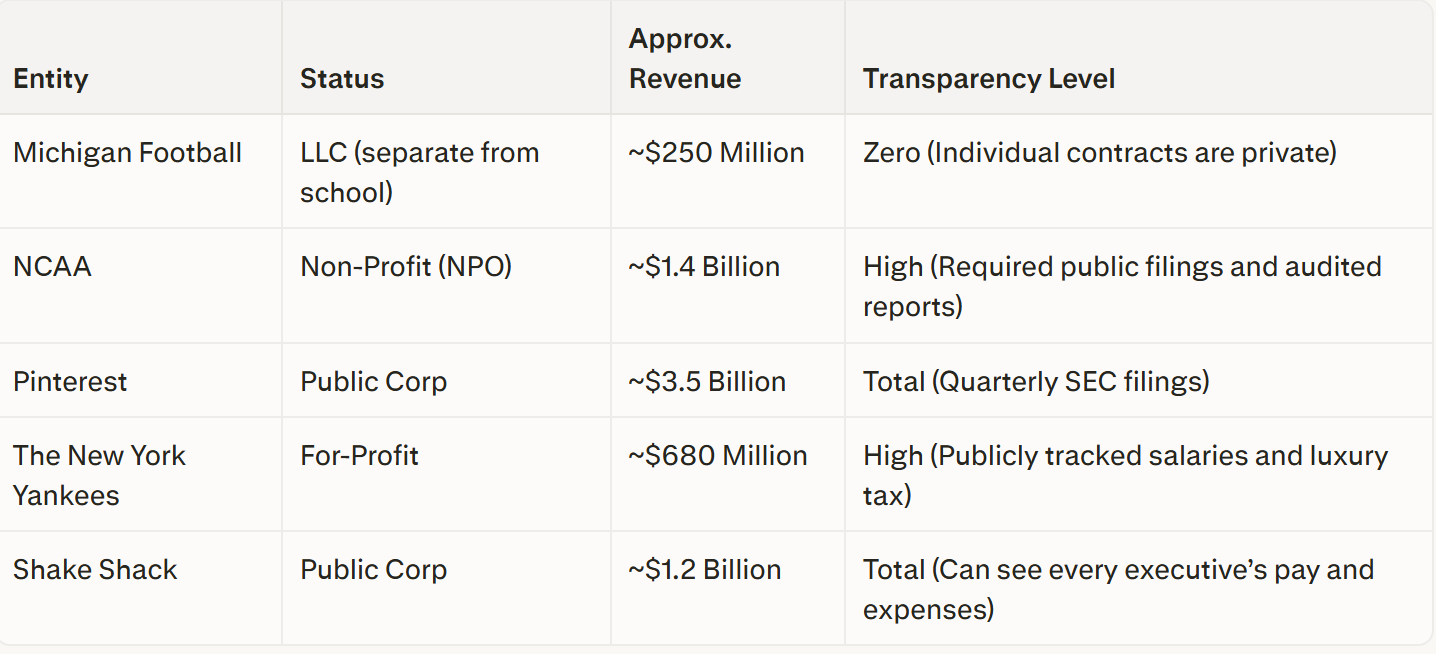
Why is it that I can easily find every contract on the Yankees payroll, the C-Suite level employee pay structure of Shake Shack and Pinterest, but I can’t find the contract details of some of the most expensive members of the University of Michigan?
John Wolfers, better known as Dr. Wolfers, one of the most well-known economists in the world, is paid $356,978. He is an employee of the University of Michigan as a professor, and his salary is publicly available. How many of the starting football or basketball players at the University are paid more than that number? Let's start with “All of them” and then work backwards to find the anomalies if need be. So, how is Michigan so transparent about professor salaries, but does not have to provide any information about its player salaries?
Let me walk you through how they pull it off. We will call this maneuver “The Shell Game.”
The University of Michigan is a non-profit organization, all public universities are, and they are forced to abide by the (FOIA) Freedom of Information Act. Translation: they are publicly audited.
But the NIL collectives are set up as 501C3’s or LLCs, so they are a private corporation that is not legally obligated to share its financials with the public. Super convenient for the University.
So while the Yankees have to disclose the 1 year $4 million contract to Paul Goldschmidt, the Michigan Wolverines can hide the Bryce Underwood contract, who is probably making more money than Paul Goldschmidt in 2026.
When a business or University gets audited, they are required to disclose employee compensation because of a “cost of talent” principle embedded into the law. Microsoft shareholders deserve to know what they are buying into, Yankees fans deserve to know how management is functioning, and likewise, college football stakeholders — anyone who watches the sport or participates in funding it — deserve to know how Schools use their funds to pay players.
The 501C3/LLC loophole is bullshit. The collective is not a separate entity from the University of Michigan. The players being paid millions of dollars to play their sport benefit from being associated with the University of Michigan. Bryce Underwood, Michigan Quarterback, holds a lot more weight than Bryce Underwood, Duquesne Quarterback (go Dukes). The players aren’t playing games for the Michigan Champions Circle (the collective name).
*If you want to murder the ethics of the sport, at least do it with a well-thought-out name. My half-baked idea is “The Wolverine of Wall Street.”
If they were playing for the Michigan Champions Circle, then that’s what the front of their Jersey should say, and that’s what their degree should say. But that’s obviously not the case, so they should be held to the same auditing practices as the institution it plays for. Not the Shell corporation that was specifically created to avoid transparency. So, legally speaking, Bryce Underwood is the quarterback of the Michigan Champions Circle, because that is who is responsible for his contract negotiations and reporting.
Just because this is such a ridiculous way to avoid transparency, I looked up some of the funniest fund names…
Marcel Reed, Quarterback for “The Fund” (Texas A&M)
TJ Simpkins, Point Guard for “Hall Hands on Deck” (Seton Hall)
Brendan Soresby, Quarterback for “Dark Horse Collective” (Texas Tech)
This stuff is seriously hilarious. Texas Tech’s argument for why it shouldn’t have to disclose contracts to the public is, “We don’t pay the athletes; the fund pays the athletes. I know we set the fund up, get alumni to donate to it, give it our brand, and schedule all the games, practices, and lifts for our student-athletes, hire all the coaches, but guys, it’s the fund”. I don’t want to get too granular, but most of the big schools have multiple funds that pay portions of each player’s salary, which further increases the lack of transparency.
The fix is straightforward: NIL collectives should be legally classified as extensions of their universities, not independent entities. If the University of Michigan’s name, brand, and stadium are what make Bryce Underwood worth millions, then Michigan owns that contract, and Michigan should have to disclose it to the public.
Problem 2: NCAA Has No Power as a Governing Body
The NCAA is currently a powerless governing body. How so, you might be asking. In hearing that, I would laugh and raise you around 100 examples of this that have happened in the last 100 days.
You have the Diego Pavia “junior college shouldn’t count” lawsuit. The Charles Bediako “I know I played in the NBA, but I’m backkk” lawsuit. The Trinidad Chambliss, “I should get 5 years, not 4” lawsuit. While all of these athletes have different facts or issues that are specific to their claims, the main point that connects all of these claims together is what happened after the NCAA ruled on their appeals or waivers. In each of these cases, these athletes and their counsel underwent the proper steps of filing waivers or appeals for eligibility, but the NCAA ruled against their claim and denied their eligibility.
The problem here lies in the next few legal steps. The savvy lawyers representing these athletes worked around the NCAA legal council and went to their local state courthouses, filing lawsuits against the NCAA for “antitrust issues”.
**Antitrust: relating to legislation preventing or controlling trusts or other monopolies, with the intention of promoting competition in business.
You see, because the NCAA lacks any actual governing power, players are allowed to bypass their rulings entirely and take their claims to state court. Think of it like this: the NCAA is like Mom saying no to the new iPad, so the athletes go straight to Grandma and Grandpa (the state courts), knowing they'll get a yes. The next step in theory should be to appeal within the NCAA's own court system, but why would any athlete do that when state courts keep ruling in their favor?
Essentially, antitrust claims argue that by denying eligibility, the NCAA is directly limiting these athletes’ earning power and market value. And in most courtrooms, that argument has been winning — hard to rule against a kid when your alma mater might win a few more ball games. For every case that an athlete has filed against the NCAA, this has been the core of their argument. Most of these cases have resulted in rulings overturning the NCAA decisions, except for the Joey Aguilar one, which the NCAA actually won.
A massive issue is lying in plain sight when the United States Judicial System has ruled one way, while the NCAA, which has no real backing or power, has ruled another. This creates a situation, as we have seen in the Trinidad Chambliss case, where the NCAA is essentially fighting the same issue in two different places. And while I cannot sit here and tell you what will result from that one or the various other lawsuits that resulted from initial NCAA decisions, I do have a solution that can stop this from happening again.
The solution revolves around legislation from Congress or even an executive order from President Trump that will grant the NCAA power to govern college athletics. There are several approaches to this, with some wanting a widespread antitrust governance authority that would essentially allow the NCAA to control everything, and then others wanting it to be limited to antitrust issues or specific areas. The widespread antitrust approach would allow the NCAA to govern NIL, conference realignment, revenue sharing, transfers, eligibility, and many other things. The limited antitrust approach would allow the NCAA to govern very specific areas that would be granted to them, such as only eligibility or NIL issues. This one is obviously much more limited, but it comes with pros and cons relating to college athletics as a whole. I am not going to tell you which side is better because it truly depends on what all goes into the proposals, and also, political parties play a role here. However, I will take the stance and say that this is absolutely necessary for the NCAA to ever have governing authority again and for once in what seems like decades, become stable and be able to stand on its own again.
If the NCAA ever wants to return to the self-sustaining and stable entity it once was, it better be on Capitol Hill begging the legislative and executive branches to help it take action, because if they don’t, it will never occur again. And they better do it soon, before it’s too late.
Problem 3: Extreme Free Agency
In the NFL, players are legally bound via contracts to play out a certain number of years. This makes it easier for General Managers to manage their teams, because in each free agency cycle, only a certain portion of their roster is free agents.
Some guys hit free agency in 2026, some in 2027, some in 2031. Some are unrestricted free agents and can choose where they play, some are restricted free agents, which means the team that originally drafted them can always choose to match an offer another team gives.
In college football and college basketball, every single player is a free agent every year. Coaches have to fight tooth and nail to retain players they have already spent hours recruiting and developing; they have to re-recruit players every year to stay. And most of the time, the conversation isn’t being led by the guiding principles of value creation – How are you going to push me to become the very best version of myself? How are you going to make me a successful member of society for years to come? – The conversation is instead guided by a sleazy agent taking 8-20% of their client’s profit, saying, “What is the number? How much money will you give my 19-year-old client?” They couldn’t care less about teaching their clients to build wealth, graduating with a degree, or learning to face adversity.
A record number of kids are going to be finishing their college eligibility without obtaining a college degree. There are 400 guys who play in the NBA, and there are 5,500 D1 basketball players. Every year, 60 players are selected in the NBA draft, and half of them are still in the NBA 5 years later. This doesn’t account for European basketball players who never play in college (Luka or Jokic), so 30 divided by 5,500 is a 0.54% chance a player has a solid NBA career, which is generous.
Let's look at a case study, Barry Dunning Jr., Senior Guard at Pitt. Pitt had a really bad season, 4th to last in the ACC with an overall record of 13-20. Dunning averaged 11.6 points, plays hard, brings athleticism to the floor, and is an okay shooter. Dunning will most likely not be an NBA player. Since graduating high school as the #1 player in Alabama, this has been his career:
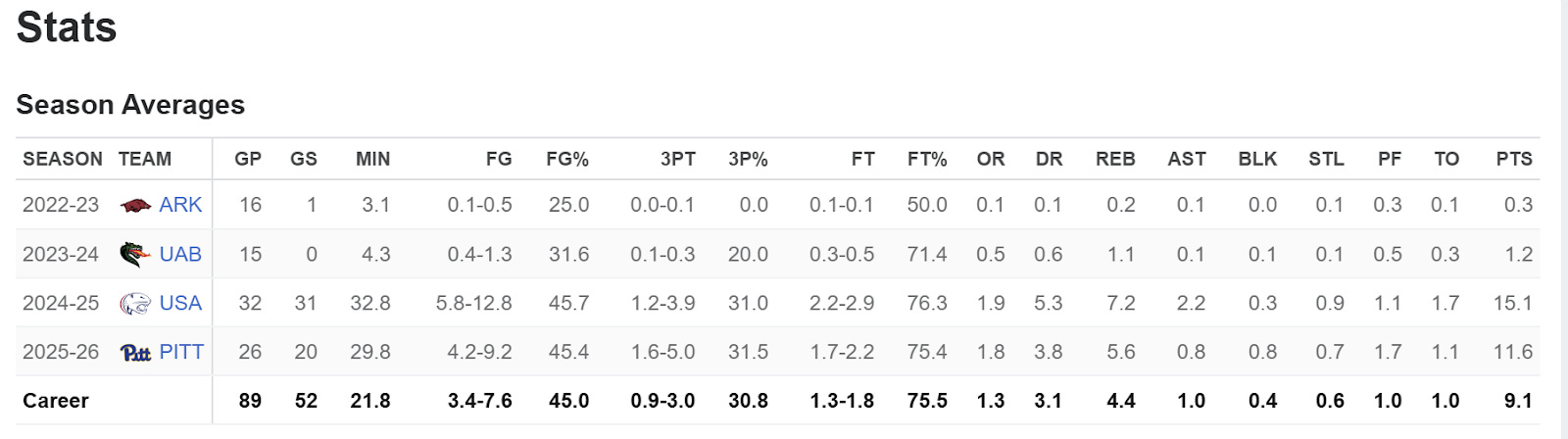
4 schools in 4 years. I don’t work in the Pitt admissions department, but I think it’s logical to speculate about how many of those credits are transferring to Pitt.
So now my argument splits into 2 schools of logic. If he doesn’t graduate from college with a degree, what a horrible precedent to set, and how many other kids are out there right now, all their athletic eligibility used up with no degree to show for it? You might as well light the NCAA mission statement on fire.
But let’s say by some miracle he does graduate college on time, this is still an ugly precedent to have. The intangible assets of college, like building lasting relationships, grinding through adversity instead of running from it, and being part of something bigger than yourself, are completely lost. When you are a hired gun for the highest bidder, you are effectively your own organization.
So how do we fix this?
The solution starts with legally binding contracts. Out of high school, when athletes sign their letter of intent, they should be required to stay two years at that University. Then pair that with a pay structure that rewards loyalty to your school. So when a player has his end-of-sophomore-year meeting, he knows that his current school is the place where he can maximize his earnings. And if a player does decide to transfer, he only gets to do it once.
Allow me to visually present this framework:
Chad Smith - Offensive Tackle, University of Michigan
Freshman year: 100k, legally bound to stay for his Sophomore year
Sophomore year: 150k, option to re-sign at Michigan or use his 1 transfer
Options: Michigan will offer to pay X, while USC is capped at only offering X - (X * 25%)
Michigan offers 300k, USC can only offer 225K
Chad returns for his junior year and signs another 2-year contract with Michigan. Michigan gets continuity, Chad maximizes his earnings, and a 19-year-old kid isn’t being shuffled around the country by an agent chasing the highest bidder.
The pushback from this model will be from sleazy agents and lawyers saying, “You are capping his earning potential, which is against his rights.”
To that, I have a legal framework to argue in a court of law: “Your honor, restricting athlete movement is not a novel concept. The NFL requires players to be three years removed from high school before entering the draft. The NBA mandates players be 19 years old and one year removed. Both leagues impose rookie wage scales that cap what first-round picks can earn on their initial contract — and both have been upheld in court. Furthermore, the National Letter of Intent that athletes already sign out of high school legally binds them to a school for one year. We are simply proposing extending that commitment to two years with the added benefit of guaranteed compensation. And when Chad signed that letter, he knew exactly what his earning potential would look like through four years of college.”
Problem 4: Capitalism in College Athletics
In 1919, the Dodge brothers, John and Horace, were 10% stakeholders in Ford and relied upon its dividends to fund their own car company. They were pissed off at Henry Ford for reinvesting company profits back into the company to A.) Pay employees more money, and B.) Make the Model T less expensive for consumers.
The Dodge brothers didn’t like this, not one bit. They argued that the point of a business is not to create value for the customer, but rather its #1 goal should be to create value for the shareholder… They basically wanted Henry Ford to pay them their dividends and make the stock go up, screw the consumers. They won the lawsuit, but at what cost?
The leading framework for American businesses is to maximize profits, and over the past decade, College Athletics has boarded that train of thought.
The two most powerful people in college athletics right now are SEC commissioner Greg Sankey and Big Ten commissioner Tony Pettiti. They will control the direction of college athletics until someone rips the power out of their grubby little hands.
But before I make them sound too evil, what do you think their job description is? Maximize profits for the Big Ten/SEC or do what's best for the health of the sport. You guessed it, make decisions that are going to pump the most money into the pockets of their member organizations.
This begs the question: Should capitalist principles be the leading economic framework for college athletics? My answer is no. Does that make me a Marxist hippy? Also no. Allow me to defend my logic with an example that comes from the hub of the capitalist world.
Among the tall corporate buildings of New York City, there is an 843-acre park that resides in the heart of the city. How come in the most expensive real estate market in America, that land can exist untouched?

This is because Central Park is considered a National Historic Landmark (NHL), meaning that, unlike the rest of the city, it operates under its own set of principles, as it is owned by the state and federal governments. The purpose of the land is not to “maximize profits” but to maintain its historical beauty and scenery.
If Central Park were to lose its status as a National Historic Landmark, how quickly do you think real-estate developers would have cranes in the ground, building a new corporate office? You see, it is important that not all of our society is designed as a for-profit enterprise. It is good to have special exceptions. And the thing about these NHL’s is they still make money! Take, for instance, Yellowstone National Park, which created $828 million in tourism for 2023.
So, as great as Yellowstone is for its local economy, the main goal is to maintain the sanctity and tradition of the land because we as a society have agreed that it is more important to have that land than not have it.
College Athletics should be a National Historic Landmark. Although the TV deals are lucrative, the point of college athletics shouldn’t be to maximize profits, but rather to maximize value for society by developing remarkable human beings who will become leaders in the world.
We have seen what has happened to the sport as it has transitioned into a for-profit entity. Regional conferences got massacred, Women’s Lacrosse teams in the Atlantic Coast Conference started traveling to the Pacific Coast for conference games, Senior days showcasing 4-year players who signed as freshmen became extremely rare, and agents and private equity firms have gotten filthy rich. The soul of college athletics is quietly being hollowed out while revenue climbs.
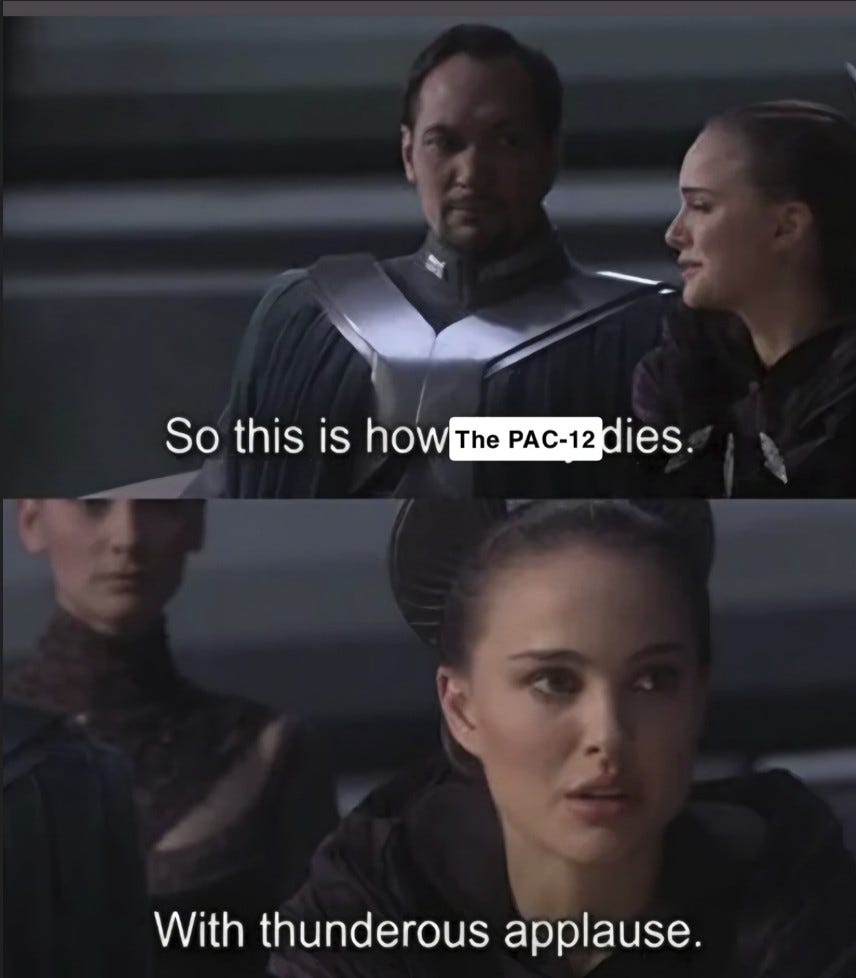
There is only one Washington Monument. Only one Mount Rushmore. And only one College Athletics. We’d best become very strategic in how we preserve this incredible ecosystem, because this uniquely American staple is not a God-given right, but rather a man-made construct that needs careful governance.
God Bless. Don’t Seek Comfort.
Written by Charlie Mill & Caleb Archer
Caleb is the Author of the Arch Madness Substack. Go check out his page!
Incredible read, and very interesting to read as an ex college athlete myself. Always wondered about the details of these issues and this article explains it nicely.
Great read as always Chuck. Was a pleasure to work on this together